
Reinheldt R-FTIR 2000
Ultra-Vision Remote Gas Analytics
The Reinheldt R-FTIR 2000 is an elite evolution in remote sensing, engineered to transform complex atmospheric data into high-definition chemical intelligence. As the 2026 global benchmark for autonomous chemical intelligence, it is designed for the most demanding industrial and environmental monitoring environments.
The R 2000 moves beyond standard spectroscopy through its integrated Deep Neural Network (DNN) Algorithm.
Tri-Stream Fusion Imaging: Seamlessly merges starlight-level visible, night-vision thermal infrared, and FTIR chemical imaging into a single, unified augmented reality overlay.
Dynamic Cloud Visualization: Generates real-time heatmaps visualizing gas cloud size, motion paths, temperature gradient fields, and concentration gradients (ppm.m).
Autonomous Leakage Tracing: Automatically locks onto gas clusters to back-calculate the precise coordinates of the leakage source, even in dense industrial zones.
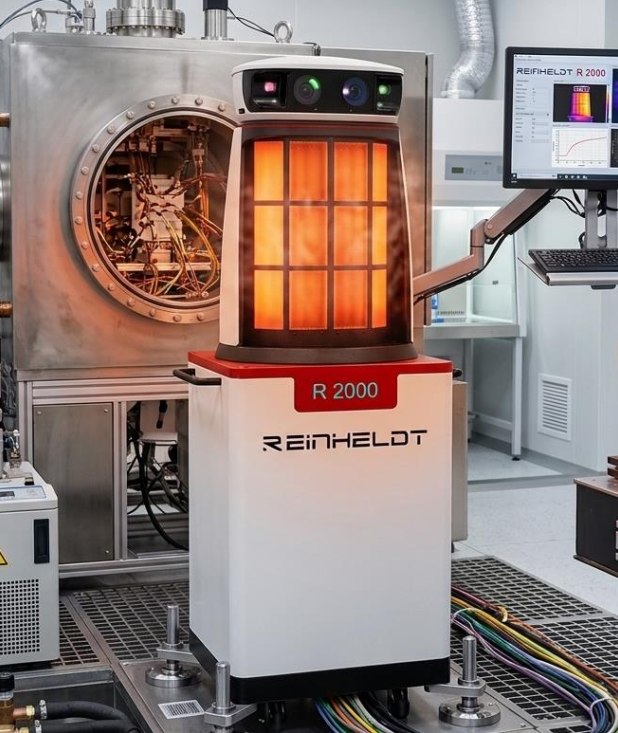
Advanced Optical System & Hardware
Interferometer Technology: Features the Reinheldt Coaxial Double-Moving-Mirror Design, which is inherently resistant to high-frequency vibrations and thermal expansion—ideal for rooftop installations or vehicle-mounted emergency patrols.
Stirling-Cooled MCT Detector: Operates at a cryogenic 200∘C using a maintenance-free Stirling cycle refrigerator. This eliminates thermal noise, allowing for trace gas detection (ppm levels) at distances up to 5 km, with a maximum visibility range of 20 km.
High-Speed Scanning: Equipped with a 360∘ horizontal PTZ and a 2D rotary galvanometer (120∘×60∘) for rapid hemispherical coverage and targeted “smart” scanning.
Industrial Safety
Continuous monitoring of petrochemical parks for fugitive VOC emissions and toxic gas leaks.
Emergency Response
On-board vehicle deployment for non-contact risk assessment at accident scenes.
Environmental Protection
Large-scale spatiotemporal mapping of air pollution and industrial discharge.
Fire Prevention
Remote detection of high-temperature heat sources and toxic combustion byproducts invisible to the human eye